Insights
Methodology for Calculating WACI
How Pathfinder calculates the Weighted Average Carbon Intensity of our Funds

1. Data gathering: Collecting Look-Through Investment Data
We begin by gathering emission data across each equity holding in each Fund. We are working on assessing data in other asset classes, but for now we exclude non-equity assets (e.g., fixed income, cash, or alternatives).
We assess the % weight of each investment in the fund for which we have relevant emission data. Adding these across the portfolio gives a ‘coverage’ ratio, which we report both on a value basis, and count basis. This indicates how much of each fund has data available.
For each fund, we take the market value % holdings with emission data, and scale these such that they sum to 100%. This provides the WACI for each fund and allows for a like-for-like comparisons across funds and minimises distortions that could arise from individual investments or asset classes lacking comprehensive emissions reporting.
2. Understanding Emissions: Scope 1, 2, and 3
We follow the widely used Greenhouse Gas protocol (GHG Protocol)[1] definitions:
Scope 1: Direct emissions from a company’s own operations (e.g., company facilities, company vehicles).
Scope 2: Indirect emissions from purchased electricity, heating, or cooling.
Scope 3: All other value-chain emissions, including suppliers and customers (e.g., use of sold products, business travel, logistics).
At present, Scope 3 emissions data is much less reliable than Scopes 1 and 2. Thus, we focus on scope 1 and 2 in our reporting. Some companies do not report Scope 3 at all, while others choose to report on only selected categories. Because companies have discretion over which categories to include, and because methodologies vary widely, Scope 3 figures do not currently allow for a comprehensive, fair, apples-to-apples comparison across companies or sectors. However, we want to support the use of broader and more comprehensive emission data across the economy over time – even it is far from perfect. For this reason, we also publish scope 3 estimates across our portfolio.
Readers seeking more background on emissions categories may refer to explainers from the GHG Protocol[1], or other climate-focused NGOs.
3. Using Refinitiv Data
Carbon emissions and revenue data come from Refinitiv (our third-party data provider). Historically, Refinitiv has supplied a mixture of company-reported data and modelled estimates. For this report, we have ensured that our calculations use only Refinitiv data fields that draw directly on company-reported emissions and revenue following the GHG Protocol, and we have excluded estimates from our WACI calculations.
To ensure data quality, we also manually reviewed and adjusted certain emissions figures (particularly Scope 2) where we identified anomalies or suspect values from the data provider. Our hierarchy for Scope 2 emissions is:
- Use company-reported market-based [2] Scope 2 where available
- If unavailable, use location-based [2] Scope 2
- If either figure looks unreliable, we may consider other sources or adjustments.
We use this hierarchy to make sure our results are as accurate and fair as possible, while staying true to what companies actually report.
4. Calculating WACI Using PCAF Guidance
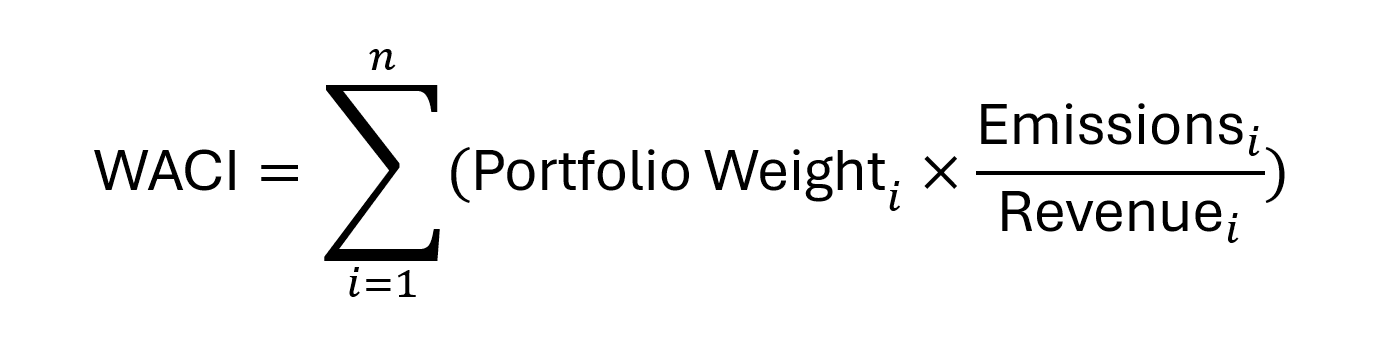
We apply the PCAF (Partnership for Carbon Accounting Financials) methodology[3] to calculate each fund’s Weighted Average Carbon Intensity (WACI)
The formula is above; where for each company:
- Emissions are Scope 1 + Scope 2
- Revenue is measured in USD millions
- Portfolio Weight is the rescaled equity-only exposure
We apply a “like-for-like” methodology consistently across all funds and across each reporting period.
5. Addressing Data Gaps
When some companies do not report emissions or revenue, we take steps to try to minimise the impact this has on reader’s ability to interpret these emissions data.
We do this by only calculating carbon intensity using companies that have usable data. And if certain holdings lack emissions or revenue information, they are excluded from the calculation because including them would distort the results.
We then adjust (or “scale up”) the weights of the remaining companies so that the total still adds up to 100% of the equity exposure being assessed. This ensures that the calculated intensity is not artificially reduced simply because some companies did not disclose emissions.
This approach avoids under-reporting and gives a more accurate picture of the funds’ and yardsticks’ carbon footprints, even when disclosures in the market are incomplete.
6. Coverage Reporting
We report data coverage (i.e. the proportion of a fund’s equity exposure for which emissions and revenue data are available).
Coverage helps readers understand:
- The confidence level of the results (greater % coverage = the data are more representative of the whole portfolio)
- The extent to which possible disclosure gaps in the corporate sector may limit precision
Higher coverage leads to more reliable outcomes whereas lower coverage indicates that results require more caution in interpretation.
7. Limitations of the Data
Although WACI is widely used, several limitations apply:
1) Variability in reporting quality: Companies report emissions using different methodologies, boundaries (defines which parts of a company’s operations and value chain are included when calculating its emissions), and assumptions.
2) Scope 3 uncertainty: Scope 3 data is often incomplete, incomparable, or based on modelled estimates.
3) Time lags: Corporate emissions disclosures typically lag by 6–18 months due to reporting cycles. Additionally, data available from data providers (like Refinitiv) may lag by a few months. To ensure our data is as accurate as possible, our ESG analyst spot-checks information extracted from our data providers.
4) Equity-only approach: Our exiting approach to exclude other asset classes can change relative fund intensity depending on portfolio composition. As noted above, we are working currently on adding other asset classes.
Over time, we hope to address these limitations but always strive for completeness and full transparency.
Sources & Further Reading
[1] https://ghgprotocol.org/corporate-standard
[2] Location-based Scope 2 emissions are calculated using the average emissions from the electricity grid in the place where the energy is used. Market-based Scope 2 emissions are calculated using the emissions from the specific electricity a company buys through contracts or renewable energy products. More details are available in the GHG Protocol Scope 2 Guidance (2015) https://ghgprotocol.org/scope-2-guidance.
[3] PCAF is an international standard that helps financial institutions measure and report the greenhouse gas emissions linked to the companies and assets they finance. For more information, see the PCAF Standard: https://carbonaccountingfinancials.com/standard